 |
 |
 |
 |
 |
 |
 |
Generation One
Pong
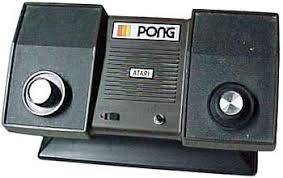
Pong is one of the earliest arcade video games. It is a table tennis sports game featuring simple two-dimensional graphics. The game was originally manufactured by Atari, which released it in 1972. Allan Alcorn created Pong as a training exercise assigned to him by Atari co-founder Nolan Bushnell. Bushnell based the idea on an electronic ping-pong game included in the Magnavox Odyssey, which later resulted in a lawsuit against Atari. Surprised by the quality of Alcorn's work, Bushnell and Atari co-founder Ted Dabney decided to manufacture the game.
Pong quickly became a success and was the first commercially successful video game, which helped to establish the video game industry along with the first home console, the Magnavox Odyssey. Soon after its release, several companies began producing games that copied Pong's gameplay, and eventually released new types of games. As a result, Atari encouraged its staff to produce more innovative games. The company released several sequels that built upon the original's gameplay by adding new features. During the 1975 Christmas season, Atari released a home version of Pong exclusively through Sears retail stores. It was also a commercial success and led to numerous copies. The game has been remade on numerous home and portable platforms following its release. Pong is part of the permanent collection of the Smithsonian Institution in Washington, D.C. due to its cultural impact.
Magnavox Odyssey
The Magnavox Odyssey is the first commercial home video game console. It was developed by a small team led by Ralph H. Baer at Sanders Associates and released by Magnavox in the United States in September 1972 and overseas the following year. The Odyssey consists of a white, black, and brown box which connects to a television set and two rectangular controllers attached by wires. It is capable of displaying three square dots on the screen in monochrome black and white, with differing behaviour for the dots depending on the game played, and with no sound capabilities. To go along with the games, and a peripheral controller—the first video game light gun—was sold separately.
The idea for a video game console was thought up by Baer in August 1966, and over the next three years he, along with Bill Harrison and Bill Rusch, created seven successive prototype consoles. After releasing the console in September 1972 through their dealerships, Magnavox sold between 69,000 and 100,000 units by the end of the year, and 350,000 by the time the console was discontinued in 1975. The console spawned the Magnavox Odyssey series of dedicated consoles, as well as the 1978 Magnavox Odyssey. One of the 28 games made for the system, a ping pong game, was an inspiration for Atari's successful Pong arcade game, in turn driving sales of the console. Baer's patents for the system and the games, including what was termed by a judge as "the pioneering patent of the video game art", formed the basis of a series of lawsuits over 20 years, earning Sanders and Magnavox over US$100 million. The release of the Odyssey marked the end of the early history of video games, and the rise of the commercial video game industry along with the start of the first generation of video game consoles.
 |
|
